

Deadline: March 31, 2025
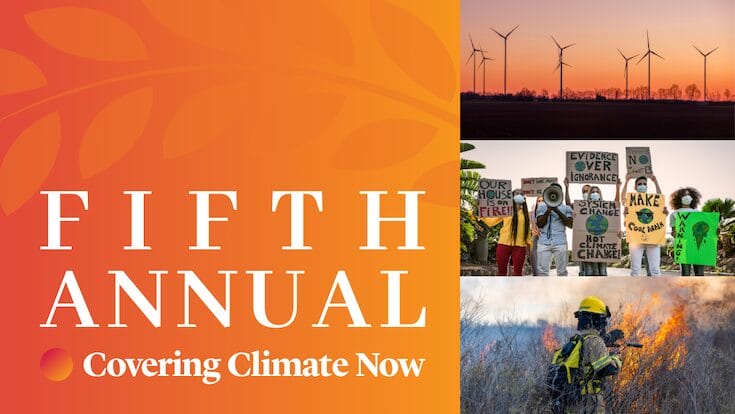
The Covering Climate Now Journalism Awards, now in their fifth year, honor excellent reporting on critical dimensions of the climate story, from throughout the world. This award is for three journalists who demonstrate exemplary commitment to the climate story and whose work has had a transformative impact on their profession. Great storytelling is a must, but otherwise the excellence they aim to recognize in this category will come in many forms.
Factors that judges may consider include, but will not be limited to, a nominee’s remarkable engagement with audiences and their community, a nominee’s attention to an underreported or challenging aspect of the climate story; a nominee’s innovative spirit and advocacy for climate coverage within their newsroom, and a nominee’s investment in fellow journalists, such as through collaborative work, teaching and mentorship roles, and involvement in journalism professional organizations.
A nominee may self-submit or be submitted by an editor, supervisor, or other professional colleague. For this entry, you’ll be asked to provide five stories — including articles, visuals, broadcast segments, and/or major media appearances — that are demonstrative of the nominee’s work, at least three of these must be from 2024.
Eligibility
- Submissions are accepted from journalists everywhere, representing news outlets big and small, as well as freelancers. Outlets may also submit several entries by different journalists.
- All eligible work must have been published or broadcast in 2024. There are exceptions in the “Large projects & collaborations,” “Emerging Journalists,” and “Journalists of the Year” categories; entries in those categories may include work from past years or 2025 for up to two of the five required pieces.
- Journalistic work in all mediums is eligible, including but not limited to writing, audio, video, photography, multimedia, editorial cartoons, and data. All journalistic styles are also eligible, including but not limited to breaking news, feature reporting, opinion/commentary, investigations, newsletters, and documentaries. They cannot accept books or academic work.
- Submission entry information must be provided in English. If the original work is not in English, please provide English-language translations in addition to the original work as an attachment.
- Finally, stories must be about climate change, not just the environment. While all climate stories are environmental stories, not all environmental stories are climate stories. Stories that primarily focus on environmental issues such as toxic pollution or endangered species where the impacts or root causes are not climate change–related are typically not considered climate stories, even if the stories may briefly mention climate change. Environmental stories that do significantly consider climate implications, such as the effects of deforestation on carbon storage, are eligible for submission.
Exceptional climate storytelling that upholds the highest standards of journalism. Great work may be marked by any of the following qualities:
- Makes climate change accessible for audiences, with stories rooted in science but not bogged down by it.
- Demonstrates the human dimensions of the climate story.
- Holds power to account and calls out disinformation and unethical behavior.
- Emphasizes the disproportionate impacts of climate change on communities of color, Indigenous peoples, the poor, women, children, and other marginalized people.
- Examines solutions emerging from all sectors of public life, including policy solutions and solutions stemming from community initiatives.
- Breaks climate news out of the rut of partisan framing and demonstrates how the climate emergency is a collective problem that transcends partisan politics and other social fault lines.
For more information, visit
To apply, click here

Leave a Reply
You must be logged in to post a comment.